




Deeper guidance and source links
If you want the full rationale behind the framework, use the detailed sections below. They preserve the long-form guidance, workflow explanation, and source links from the original page while the sections above handle faster routing.
How the Framework Works in Practice
A framework only becomes useful when it turns into a repeatable workflow.
In practice, reliable tracking is not one action. It is a controlled sequence: define naming, build the URL, validate the link, test the redirect path, and log the live asset. Each step prevents a different class of failure.
1. Define naming rules
Start by deciding the campaign values before anyone builds the final URL. This is where source, medium, campaign, and any supporting taxonomy rules should be agreed and standardised.
This step prevents inconsistent naming, duplicate campaign rows, and reporting drift across teams.
Use the UTM Naming Generator to define controlled values before links are created.
2. Build the final URL
Once naming is agreed, assemble the final campaign URL using the approved values. The goal here is not creativity. It is accuracy and consistency.
This step prevents malformed links, missing parameters, and avoidable build mistakes that create reporting noise later.
Use the UTM Builder after naming is confirmed.
3. Validate the link before publish
Before a link goes live, check the finished URL for parameter issues, landing-page mistakes, and avoidable QA failures.
This step prevents bad campaign links from being published under pressure or copied across channels without review.
Use the UTM QA Checker as the validation step before publish.
4. Test the redirect path
If the published URL passes through a redirect, test the live path instead of assuming it behaves correctly. Redirect type, chain length, parameter survival, and final destination all matter here.
This step prevents stripped UTMs, broken routing, redirect-chain issues, and false confidence in links that only look correct on the surface.
Use the Redirect Checker on the final publish URL, not just the destination page.
5. Log the live link and owner
Once the link is approved and live, record the owner, publish URL, final destination, status, and any relevant notes in a source-of-truth log.
This step prevents ownership confusion, maintenance blind spots, and the slow decay that happens when links are published without a usable record.
Use the campaign tracking spreadsheet to log the live asset properly.
Used together, these five steps turn attribution from a fragile tagging task into a governed workflow that is easier to maintain, audit, and trust over time.
Where AI Fits in This Framework
AI can speed up repeatable tasks like naming assistance, QA preparation, documentation, and workflow support. It does not replace governance, ownership, redirect checks, or attribution judgement.
Use AI automation and automate business with AI after the rules are stable and the workflow is already governed.
Go to the Layer That Matches Your Problem
Understand the system
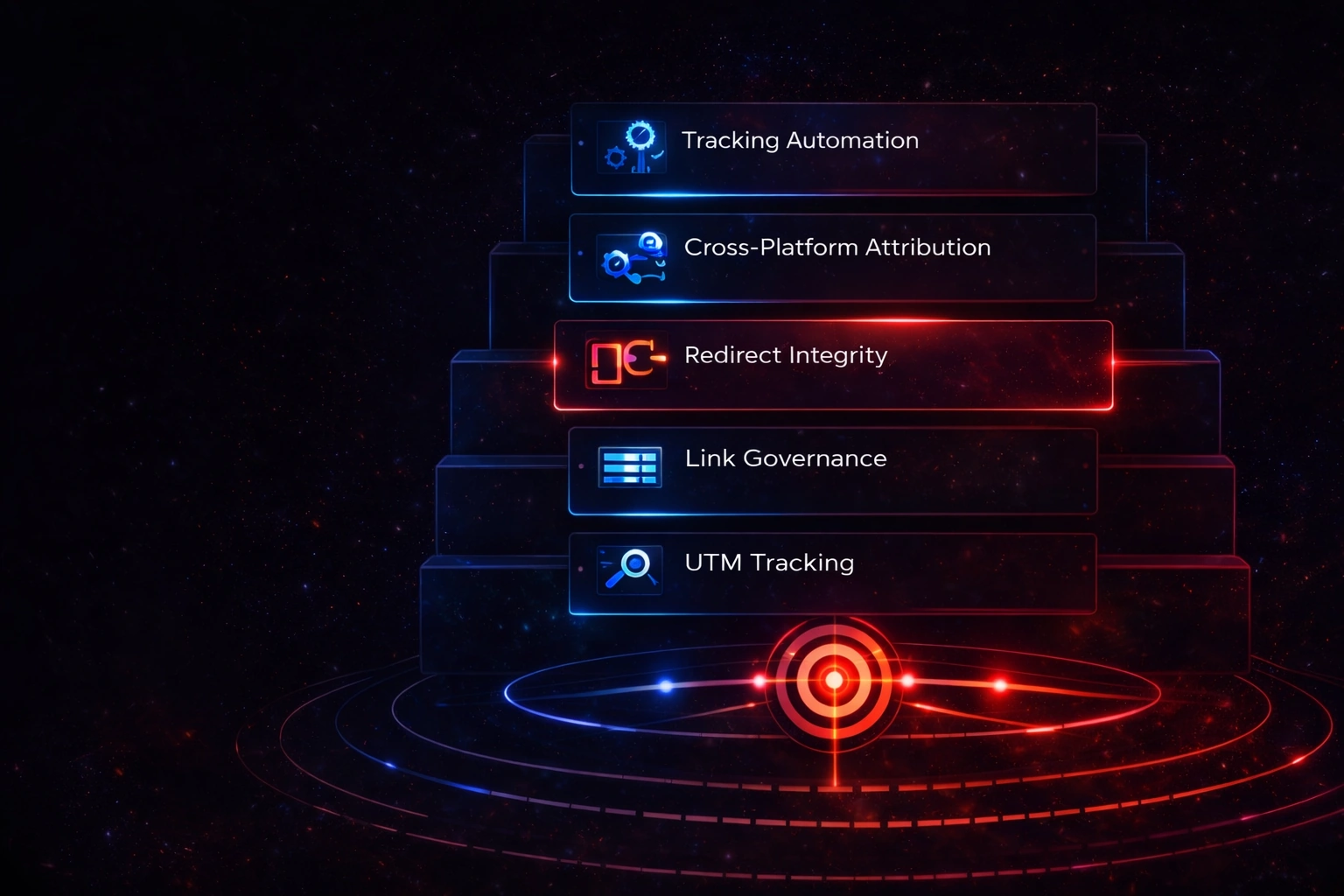
UTM tracking · link governance · redirect integrity · cross-platform attribution · tracking automation
If someone still needs the plain-English bridge before moving into a specific layer, start with UTMs and attribution explained and then route into the control layer that matches the failure.
Fix a current problem
GA4 direct / unassigned · why GA4 and affiliate data disagree · where UTMs show in GA4 · UTM mistakes that ruin tracking · do redirects remove UTMs?
Start using the workflow
Tools · UTM Naming Generator · UTM Builder · UTM QA Checker · Redirect Checker
Reviewed by: Dean Downes, editor at Shortlinkfix. See our editorial policy and suggest a correction.